← The Work

David Andrew Furniture

davidandrewfurniture.com

David Andrew Furniture — the live site

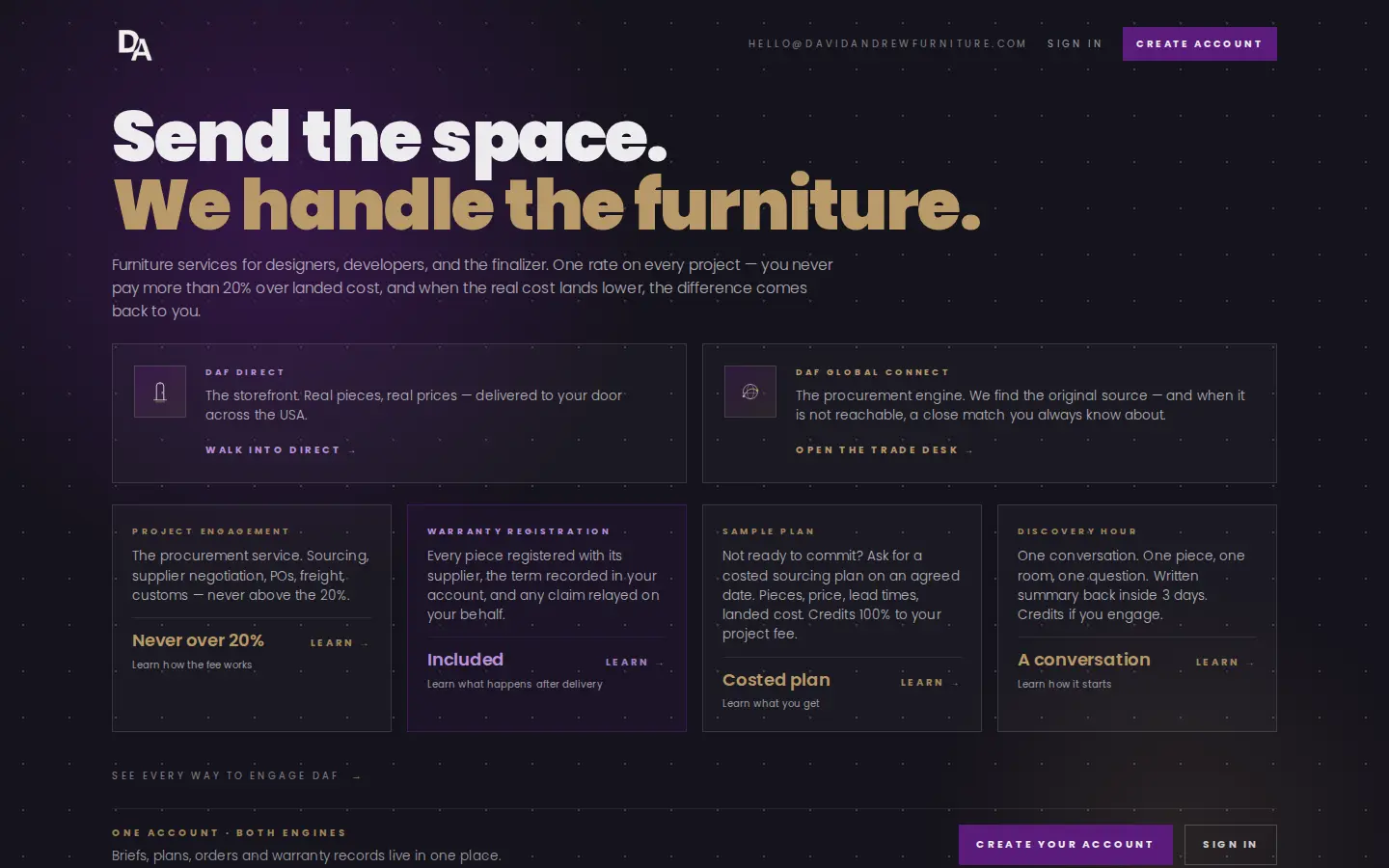
David Andrew Furniture — a procurement business, online at last

What it is

David Andrew Furniture is a real furniture procurement and services business in the Okanagan. It sources furniture for offices, hospitality, and residential projects, and runs the surrounding services — design, project management, installation, maintenance, and decommissioning. Like most trade businesses, it had the expertise and no way to show it. Quotes lived in email threads. The knowledge that took years to accumulate was invisible to every prospective client.

What we built

A full site on davidandrewfurniture.com that turns how the business actually works into the sales pitch. Instead of hiding pricing behind "contact us", the site is education-first: it explains dealer markups, landed cost, and what a furnished project actually runs, in plain Canadian English. Visitors can preview a costed plan — real line items, real fee structure — before they ever commit. The `/procurement` route is the conversion target: a brief intake that captures scope, budget, and timeline, so the first conversation starts informed rather than cold. Every page on the site points back to it.

The knowledge library is the CEO Playbook: a 33-chapter library covering construction, brands, logistics, negotiation, finance, and client segments. It is wired into the site's answers, so domain questions get grounded responses from a furniture corpus, not generic web copy.

The engineering

Next.js on Vercel edge. Self-hosted fonts, so no third-party tracking requests and no layout shift. A layered CSS background system — the ember and dusk set — that gives the site depth without shipping heavy images, which keeps pages fast on a phone over hotel Wi-Fi. Content is built from markdown sources, so updating the library or the playbook is a build, not a rewrite.

What the business gets

A site that does the qualifying work. Prospects arrive already understanding how furniture procurement is priced, which shortens the sales cycle and filters out tyre-kickers. The costed plan preview builds trust the usual brochure site cannot — it shows the math before asking for the business. The procurement funnel captures briefs as they arrive and the library keeps proving expertise on every page. If we are not at a desk when one lands, it waits for us — we would rather say that than promise an instant answer. It is the difference between a business card and a working asset.

Start yours

The same four steps built this site; a human checked every page before it shipped. The client owns it outright — code, content, domain, everything. If your business has real expertise that the internet cannot see, that is exactly the problem we solve.

Start your build at nimoswebsites.com/start

THE BRIEF

A procurement business with years of expertise — and no site that showed it.

HOW IT RAN — THE SIX STEPS

  1. BRIEF

    The trade, the buyers, the knowledge that email threads were hiding.

  2. SCOPE

    Education-first: landed cost, the fee structure, a costed-plan preview — agreed in writing.

  3. POLICIES

    The two policies — written once, versioned and dated.

  4. ACCOUNT

    Domain, hosting and content, registered in the business's name.

  5. BUILD

    Design, build, audit — a human read every page before launch.

  6. RUNNING

    Live at davidandrewfurniture.com, with briefs captured at /procurement.

WHAT CHANGED

  • The expertise is on the page — the CEO Playbook grounds the site's answers.
  • The math comes before the ask — the costed-plan preview shows the structure before anyone commits.
  • The brief now waits at /procurement — the first conversation starts informed, not cold.

The stack it runs on

Beyond the eight rails on the home page — the whole bench this build actually runs on, and what each piece does here.

Next.js

the framework the site is built on — server-rendered, fast, no layout shift

Vercel

edge hosting — pages stay fast on a phone over hotel Wi-Fi

Shopify

the product catalog the costed plans draw from

Stripe

the payments rail behind deposits on awarded plans

Google Business Profile

how Okanagan searches find the business

Supabase

stores the procurement briefs captured at /procurement

Resend

the rail for the site's own notifications

PostHog

traffic the business actually reads, in plain numbers

Sentry

errors surface to us before they surface to a client

GitHub

every line reviewed and versioned before it ships

Every tile is a tool this build really runs on. Tools, not partnerships.

The artifact the site sells with

The costed plan preview is the trust move: the math is shown before the business is asked for. This is its structure — the real plan carries the real numbers, line by line.

COSTED PLAN — STRUCTURE

THE MATH, BEFORE THE ASK

Landed cost

furniture · freight · duty · inspection · delivery

The DAF fee

20% of landed cost — one line, never buried

The costed plan

line items a client can check before committing

LANDED COST — THE ROWS

Furniture

Freight

Duty & clearance

Inspection

Last-mile delivery

DAF fee — 20% of landed cost

The costed plan

Structure only — slots mark where a number sits. No placeholder figures, because the real plan is the honest one.

The eight rails, annotated

The home page shows a wall of eight rails. Here is the role each one plays on this build, specifically.

Next.js

the framework the whole site is built on — server-rendered, fast, no layout shift

Vercel

edge hosting — pages stay fast on a phone over hotel Wi-Fi

Stripe

the payments rail behind deposits on awarded plans

Shopify

the product catalog the costed plans draw from

GitHub

every change reviewed and versioned before it reaches the site

Supabase

stores the procurement briefs captured at /procurement

Google

Google Business Profile — how Okanagan searches find the business

Resend

the rail for the site's own notifications

Your build starts the same way.

File the brief