← The Work

Motion Menu

motionmenu.ca

Motion Menu — the live site

Motion Menu — the design system behind every Nimos build

What it is

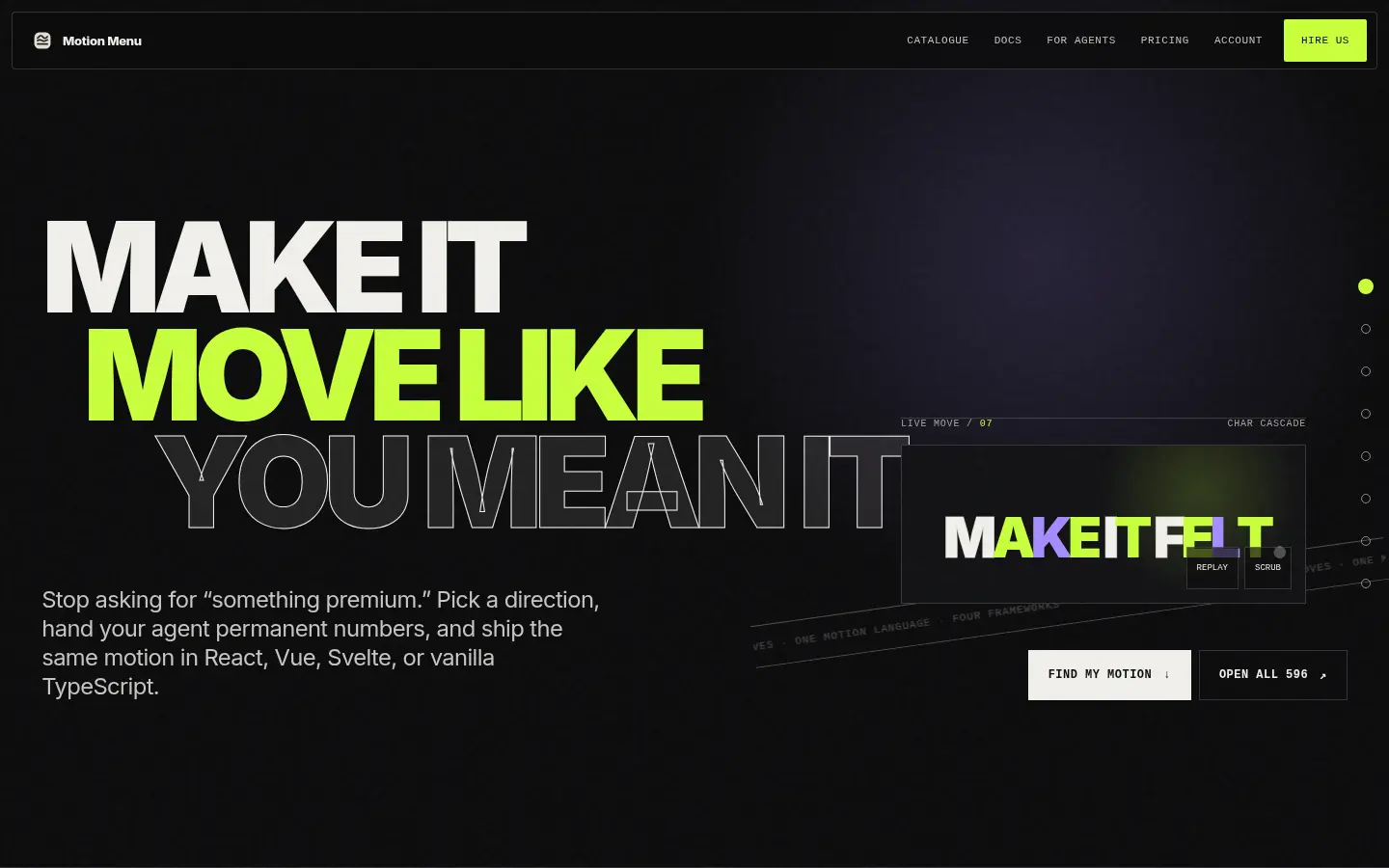
Motion Menu is a numbered library of 597 working motion and design patterns — real HTML, CSS, and JavaScript, not screenshots or abstractions. It lives at motionmenu.ca, and it is not a client project in the usual sense. It is the design system Nimos Websites builds from. When you hire Nimos, your site inherits it.

What we built

A real site with live pattern demos: every pattern runs in the browser, on the page, so you judge it by how it moves rather than how it is described. The library is organised by role — hero, navigation, pricing, footer, background — and by technique, including scroll-driven work, WebGL, and seam transitions between sections. Patterns carry permanent numbers and slugs, so a build can reference "pattern 84" and get the same code every time.

Two agent-facing surfaces make it readable by software. A shadcn-compatible registry output means patterns drop into component-based projects without hand-porting. And `/p/<n>.md` endpoints serve each pattern's code as plain markdown, which is how the Nimos agents read it mid-build. The library was written to be used by software as much as by people.

The engineering

The patterns are self-contained: HTML, CSS, and JS with no framework lock-in, plus wrappers for React, Vue, and Svelte when a project calls for components. The registry is generated from the same source as the demos, so there is one truth, not a demo that drifts from the docs. Static delivery keeps the whole thing fast and cheap to run. Every pattern is numbered and versioned, so a quality check can name exactly what shipped.

What the business gets

Consistency and speed. Most agencies start each project from a blank file and charge you for the blank file. Nimos starts from 597 tested patterns, which is a large part of how a complete site ships in 3–5 weeks, not quarters. Your build gets motion and interaction design that would otherwise be a separate engagement with a specialist studio — scroll work, section seams, live backgrounds — because the patterns are already written, tested, and proven in a browser.

It also means your site is not a one-off nobody can maintain. The patterns are documented, numbered, and publicly inspectable at motionmenu.ca. Another developer can pick up your site and see exactly what it is built from.

Start yours

The same four steps build and maintain this library; a human checks the work. Clients own their sites forever — and every one of those sites is built on 597 patterns that are already working.

Start your build at nimoswebsites.com/start

THE BRIEF

One permanent home for a studio's motion work — numbered, demoed live, readable by software.

HOW IT RAN — THE SIX STEPS

  1. BRIEF

    One line of intent: the studio's motion work, made public and permanent.

  2. SCOPE

    The library, the live demos, and the code served to other builds — agreed in writing.

  3. POLICIES

    The two policies — written once, versioned and dated.

  4. ACCOUNT

    Domain, hosting and content, registered in the studio's name.

  5. BUILD

    Design, build, audit — each pattern judged in a real browser, not a screenshot.

  6. RUNNING

    Live at motionmenu.ca — 597 patterns, each one demoed in the browser.

WHAT CHANGED

  • The motion work became a citable system — 597 patterns, numbered and versioned.
  • Builds read it by number — “pattern 84” returns the same code every time.
  • Nimos builds start from it — tested patterns, not a blank file.

The stack it runs on

How the library is drawn, typed, demoed, QA'd, and delivered — the real bench behind all 597 patterns.

Figma

where patterns are drawn before a line of code exists

TypeScript

typed pattern interfaces, so an agent cannot misuse one

React

component wrappers for React projects

Tailwind CSS

the utility layer this site and the registry are styled with

GSAP

the animation toolkit under the scroll-driven patterns

Lenis

the smooth-scroll physics the scroll work rides on

Vercel

static delivery — the whole library, fast and cheap to run

GitHub

one source of truth, versioned and publicly inspectable

Chrome DevTools QA

every pattern judged in a real browser, not a screenshot

Sentry

when a demo breaks, we know before anyone reports it

WebGL scenes

shader backgrounds and 3D work, gated by device tier

The agent MCP

how Nimos agents read patterns mid-build, by number

Every tile is a tool this build really runs on. Tools, not partnerships.

How a pattern reaches your build

Four layers, one source. A client’s site inherits the whole path — which is why the motion arrives tested, not improvised.

The library

597 working patterns — real HTML, CSS, and JS, numbered, versioned, demoed live in the browser

One pattern

self-contained and framework-free, with a permanent number — a build can ask for “pattern 84” and get the same code every time

The framework registry

wrappers generated from the same source as the demos — one truth, no drift between demo and docs

ReactVueSvelteVanilla

shadcn output

drops into component-based projects without hand-porting — and /p/<n>.md serves the code for agents mid-build

597

working patterns, every one demoed live in the browser

3

framework wrappers, generated from the same source

1

registry of truth — the demo never drifts from the docs

The library’s own counts — nothing added, nothing rounded up.

Your build starts the same way.

File the brief